


Page 14 - Demo
P. 14
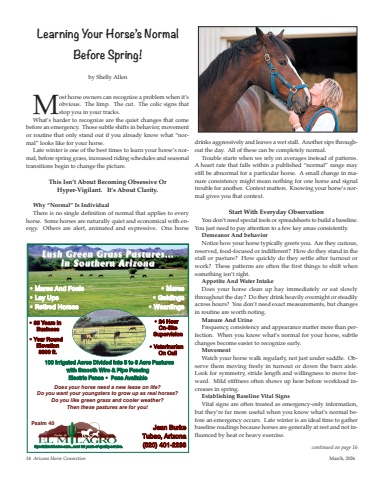
Most horse owners can recognize a problem when it%u2019sobvious. The limp. The cut. The colic signs thatstop you in your tracks.What%u2019s harder to recognize are the quiet changes that comebefore an emergency. Those subtle shifts in behavior, movementor routine that only stand out if you already know what %u201cnormal%u201d looks like for your horse.Late winter is one of the best times to learn your horse%u2019s normal, before spring grass, increased riding schedules and seasonaltransitions begin to change the picture.This Isn%u2019t About Becoming Obsessive Or Hyper-Vigilant. It%u2019s About Clarity.Why %u201cNormal%u201d Is IndividualThere is no single definition of normal that applies to everyhorse. Some horses are naturally quiet and economical with energy. Others are alert, animated and expressive. One horsedrinks aggressively and leaves a wet stall. Another sips throughout the day. All of these can be completely normal.Trouble starts when we rely on averages instead of patterns.A heart rate that falls within a published %u201cnormal%u201d range maystill be abnormal for a particular horse. A small change in manure consistency might mean nothing for one horse and signaltrouble for another. Context matters. Knowing your horse%u2019s normal gives you that context.Start With Everyday ObservationYou don%u2019t need special tools or spreadsheets to build a baseline.You just need to pay attention to a few key areas consistently.Demeanor And behaviorNotice how your horse typically greets you. Are they curious,reserved, food-focused or indifferent? How do they stand in thestall or pasture? How quickly do they settle after turnout orwork? These patterns are often the first things to shift whensomething isn%u2019t right.Appetite And Water IntakeDoes your horse clean up hay immediately or eat slowlythroughout the day? Do they drink heavily overnight or steadilyacross hours? You don%u2019t need exact measurements, but changesin routine are worth noting.Manure And UrineFrequency, consistency and appearance matter more than perfection. When you know what%u2019s normal for your horse, subtlechanges become easier to recognize early.MovementWatch your horse walk regularly, not just under saddle. Observe them moving freely in turnout or down the barn aisle.Look for symmetry, stride length and willingness to move forward. Mild stiffness often shows up here before workload increases in spring.Establishing Baseline Vital SignsVital signs are often treated as emergency-only information,but they%u2019re far more useful when you know what%u2019s normal before an emergency occurs. Late winter is an ideal time to gatherbaseline readings because horses are generally at rest and not influenced by heat or heavy exercise.Learning Your Horse%u2019s Normal Before Spring!by Shelly Allencontinued on page 1614 Arizona Horse Connection March, 2026Jean Burke Tubac, Arizona(520) 401-2233%u2022 24 Hour On-Site Supervision%u2022 Veterinarian On CallSpecialized horse care...over 20 years of quality service.Psalm 40Lush Green Grass Pastures... Lush Green Grass Pastures...in Southern Arizona in Southern Arizona%u2022 Mares %u2022 Geldings%u2022 Weanlings%u2022 Mares And Foals%u2022 Lay Ups%u2022 Retired Horses%u2022 35 Years In Business%u2022 Year RoundElevation 3300 ft.Does your horse need a new lease on life? Do you want your youngsters to grow up as real horses? Do you like green grass and cooler weather? Then these pastures are for you!100 Irrigated Acres Divided Into 5 to 6 Acre Pastureswith Smooth Wire & Pipe FencingElectric Fence %u2022 Pens Available


