


Page 50 - Demo
P. 50
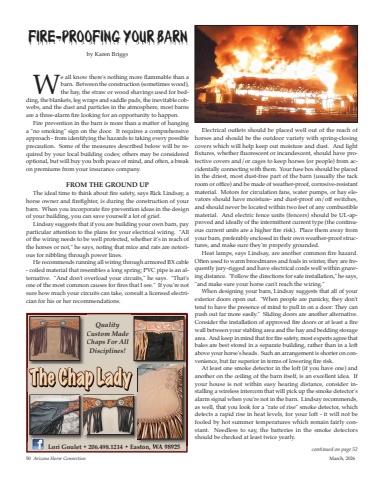
Fire-Proofing Your Barnby Karen BriggsWe all know there's nothing more flammable than abarn. Between the construction (sometimes wood),the hay, the straw or wood shavings used for bedding, the blankets, leg wraps and saddle pads, the inevitable cobwebs, and the dust and particles in the atmosphere, most barnsare a three-alarm fire looking for an opportunity to happen. Fire prevention in the barn is more than a matter of hanginga \approach - from identifying the hazards to taking every possibleprecaution. Some of the measures described below will be required by your local building codes; others may be consideredoptional, but will buy you both peace of mind, and often, a breakon premiums from your insurance company.FROM THE GROUND UPThe ideal time to think about fire safety, says Rick Lindsay, ahorse owner and firefighter, is during the construction of yourbarn. When you incorporate fire prevention ideas in the designof your building, you can save yourself a lot of grief.Lindsay suggests that if you are building your own barn, payparticular attention to the plans for your electrical wiring. \of the wiring needs to be well protected, whether it's in reach ofthe horses or not,\ous for nibbling through power lines.He recommends running all wiring through armored BX cable- coiled material that resembles a long spring; PVC pipe is an alternative. \one of the most common causes for fires that I see.\sure how much your circuits can take, consult a licensed electrician for his or her recommendations. Electrical outlets should be placed well out of the reach ofhorses and should be the outdoor variety with spring-closingcovers which will help keep out moisture and dust. And lightfixtures, whether fluorescent or incandescent, should have protective covers and/or cages to keep horses (or people) from accidentally connecting with them. Your fuse box should be placedin the driest, most dust-free part of the barn (usually the tackroom or office) and be made of weather-proof, corrosive-resistantmaterial. Motors for circulation fans, water pumps, or hay elevators should have moisture- and dust-proof on/off switches,and should never be located within two feet of any combustiblematerial. And electric fence units (fencers) should be UL-approved and ideally of the intermittent current type (the continuous current units are a higher fire risk). Place them away fromyour barn, preferably enclosed in their own weather-proof structures, and make sure they're properly grounded.Heat lamps, says Lindsay, are another common fire hazard.Often used to warm broodmares and foals in winter, they are frequently jury-rigged and have electrical cords well within gnawing distance. \\When designing your barn, Lindsay suggests that all of yourexterior doors open out. \tend to have the presence of mind to pull in on a door: They canpush out far more easily.\Consider the installation of approved fire doors or at least a firewall between your stabling area and the hay and bedding storagearea. And keep in mind that for fire safety, most experts agree thatbales are best stored in a separate building, rather than in a loftabove your horse's heads. Such an arrangement is shorter on convenience, but far superior in terms of lowering fire risk.At least one smoke detector in the loft (if you have one) andanother on the ceiling of the barn itself, is an excellent idea. Ifyour house is not within easy hearing distance, consider installing a wireless intercom that will pick up the smoke detector'salarm signal when you're not in the barn. Lindsay recommends,as well, that you look for a \detects a rapid rise in heat levels, for your loft - it will not befooled by hot summer temperatures which remain fairly constant. Needless to say, the batteries in the smoke detectorsshould be checked at least twice yearly. 50 Arizona Horse Connection March, 2026Quality Custom MadeChaps For AllDisciplines!Lori Goulet %u2022 206.498.1214 %u2022 Easton, WA 98925 continued on page 52


