


Page 34 - Demo
P. 34
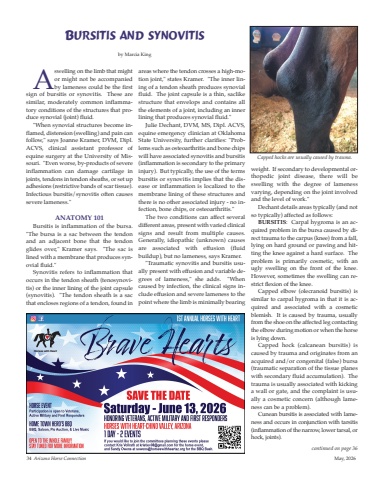
Aswelling on the limb that mightor might not be accompaniedby lameness could be the firstsign of bursitis or synovitis. These aresimilar, moderately common inflammatory conditions of the structures that produce synovial (joint) fluid. \flamed, distension (swelling) and pain canfollow,\ACVS, clinical assistant professor ofequine surgery at the University of Missouri. \inflammation can damage cartilage injoints, tendons in tendon sheaths, or set upadhesions (restrictive bands of scar tissue).Infectious bursitis/synovitis often causessevere lameness.\AnAtomy 101 Bursitis is inflammation of the bursa.\and an adjacent bone that the tendonglides over,\lined with a membrane that produces synovial fluid.\Synovitis refers to inflammation thatoccurs in the tendon sheath (tenosynovitis) or the inner lining of the joint capsule(synovitis). \that encloses regions of a tendon, found inareas where the tendon crosses a high-motion joint,\ing of a tendon sheath produces synovialfluid. The joint capsule is a thin, saclikestructure that envelops and contains allthe elements of a joint, including an innerlining that produces synovial fluid.\Julie Dechant, DVM, MS, Dipl. ACVS,equine emergency clinician at OklahomaState University, further clarifies: \lems such as osteoarthritis and bone chipswill have associated synovitis and bursitis(inflammation is secondary to the primaryinjury). But typically, the use of the termsbursitis or synovitis implies that the disease or inflammation is localized to themembrane lining of these structures andthere is no other associated injury - no infection, bone chips, or osteoarthritis.\The two conditions can affect severaldifferent areas, present with varied clinicalsigns and result from multiple causes.Generally, idiopathic (unknown) causesare associated with effusion (fluidbuildup), but no lameness, says Kramer. \ally present with effusion and variable degrees of lameness,\caused by infection, the clinical signs include effusion and severe lameness to thepoint where the limb is minimally bearingweight. If secondary to developmental orthopedic joint disease, there will beswelling with the degree of lamenessvarying, depending on the joint involvedand the level of work.\Dechant details areas typically (and notso typically) affected as follows: Bursitis: Carpal hygroma is an acquired problem in the bursa caused by direct trauma to the carpus (knee) from a fall,lying on hard ground or pawing and hitting the knee against a hard surface. Theproblem is primarily cosmetic, with anugly swelling on the front of the knee.However, sometimes the swelling can restrict flexion of the knee. Capped elbow (olecranoid bursitis) issimilar to carpal hygroma in that it is acquired and associated with a cosmeticblemish. It is caused by trauma, usuallyfrom the shoe on the affected leg contactingthe elbow during motion or when the horseis lying down. Capped hock (calcanean bursitis) iscaused by trauma and originates from anacquired and/or congenital (false) bursa(traumatic separation of the tissue planeswith secondary fluid accumulation). Thetrauma is usually associated with kickinga wall or gate, and the complaint is usually a cosmetic concern (although lameness can be a problem). Cunean bursitis is associated with lameness and occurs in conjunction with tarsitis(inflammation of the narrow, lower tarsal, orhock, joints). Bursitis And Synovitisby Marcia KingCapped hocks are usually caused by trauma.34 Arizona Horse Connection May, 2026Horses with Heartcontinued on page 36


