


Page 48 - Demo
P. 48
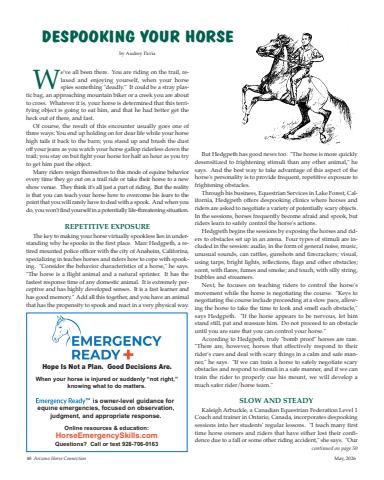
We've all been there. You are riding on the trail, relaxed and enjoying yourself, when your horsespies something \tic bag, an approaching mountain biker or a creek you are aboutto cross. Whatever it is, your horse is determined that this terrifying object is going to eat him, and that he had better get theheck out of there, and fast.Of course, the result of this encounter usually goes one ofthree ways: You end up holding on for dear life while your horsehigh tails it back to the barn; you stand up and brush the dustoff your jeans as you watch your horse gallop riderless down thetrail; you stay on but fight your horse for half an hour as you tryto get him past the object.Many riders resign themselves to this mode of equine behaviorevery time they go out on a trail ride or take their horse to a newshow venue. They think it's all just a part of riding. But the realityis that you can teach your horse how to overcome his fears to thepoint that you will rarely have to deal with a spook. And when youdo, you won't find yourself in a potentially life-threatening situation.Repetitive exposuReThe key to making your horse virtually spookless lies in understanding why he spooks in the first place. Marc Hedgpeth, a retired mounted police officer with the city of Anaheim, Califorina,specializing in teaches horses and riders how to cope with spooking. \\fastest response time of any domestic animal. It is extremely perceptive and has highly developed senses. It is a fast learner andhas good memory.\that has the propensity to spook and react in a very physical way.But Hedgpeth has good news too. \desensitized to frightening stimuli than any other animal,\says. And the best way to take advantage of this aspect of thehorse's personality is to provide frequent, repetitive exposure tofrightening obstacles.Through his business, Equestrian Services in Lake Forest, California, Hedgpeth offers despooking clinics where horses andriders are asked to negotiate a variety of potentially scary objects.In the sessions, horses frequently become afraid and spook, butriders learn to safely control the horse's actions. Hedgpeth begins the sessions by exposing the horses and riders to obstacles set up in an arena. Four types of stimuli are included in the session: audio, in the form of general noise, music,unusual sounds, can rattles, gunshots and firecrackers; visual,using tarps, bright lights, reflections, flags and other obstacles;scent, with flares, fumes and smoke; and touch, with silly string,bubbles and streamers.Next, he focuses on teaching riders to control the horse'smovement while the horse is negotiating the course. \negotiating the course include proceeding at a slow pace, allowing the horse to take the time to look and smell each obstacle,\says Hedgpeth. \stand still, pat and reassure him. Do not proceed to an obstacleuntil you are sure that you can control your horse.\According to Hedgpeth, truly \\rider's cues and deal with scary things in a calm and safe manner,\obstacles and respond to stimuli in a safe manner, and if we cantrain the rider to properly cue his mount, we will develop amuch safer rider/horse team.\slow and steadyKaleigh Arbuckle, a Canadian Equestrian Federation Level 1Coach and trainer in Ontario, Canada, incorporates despookingsessions into her students' regular lessons. \time horse owners and riders that have either lost their confidence due to a fall or some other riding accident,\DESPOOKING YOUR HORSEby Audrey Pavia48 Arizona Horse Connection May, 2026continued on page 50Hope Is Not a Plan. Good Decisions Are.When your horse is injured or suddenly “not right,”knowing what to do matters.is owner-level guidance forequine emergencies, focused on observation,judgment, and appropriate response.Online resources & education:HorseEmergencySkills.comQuestions? Call or text 928-706-0163


