


Page 38 - Demo
P. 38
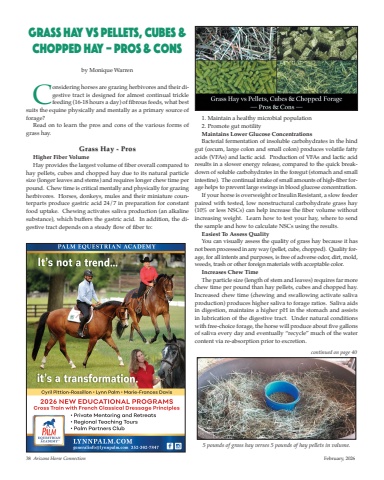
Considering horses are grazing herbivores and their digestive tract is designed for almost continual tricklefeeding (16-18 hours a day) of fibrous feeds, what bestsuits the equine physically and mentally as a primary source offorage? Read on to learn the pros and cons of the various forms ofgrass hay.Grass Hay - ProsHigher Fiber VolumeHay provides the largest volume of fiber overall compared tohay pellets, cubes and chopped hay due to its natural particlesize (longer leaves and stems) and requires longer chew time perpound. Chew time is critical mentally and physically for grazingherbivores. Horses, donkeys, mules and their miniature counterparts produce gastric acid 24/7 in preparation for constantfood uptake. Chewing activates saliva production (an alkalinesubstance), which buffers the gastric acid. In addition, the digestive tract depends on a steady flow of fiber to:1. Maintain a healthy microbial population2. Promote gut motility Maintains Lower Glucose ConcentrationsBacterial fermentation of insoluble carbohydrates in the hindgut (cecum, large colon and small colon) produces volatile fattyacids (VFAs) and lactic acid. Production of VFAs and lactic acidresults in a slower energy release, compared to the quick breakdown of soluble carbohydrates in the foregut (stomach and smallintestine). The continual intake of small amounts of high-fiber forage helps to prevent large swings in blood glucose concentration.If your horse is overweight or Insulin Resistant, a slow feederpaired with tested, low nonstructural carbohydrate grass hay(10% or less NSCs) can help increase the fiber volume withoutincreasing weight. Learn how to test your hay, where to sendthe sample and how to calculate NSCs using the results. Easiest To Assess QualityYou can visually assess the quality of grass hay because it hasnot been processed in any way (pellet, cube, chopped). Quality forage, for all intents and purposes, is free of adverse odor, dirt, mold,weeds, trash or other foreign materials with acceptable color.Increases Chew TimeThe particle size (length of stem and leaves) requires far morechew time per pound than hay pellets, cubes and chopped hay.Increased chew time (chewing and swallowing activate salivaproduction) produces higher saliva to forage ratios. Saliva aidsin digestion, maintains a higher pH in the stomach and assistsin lubrication of the digestive tract. Under natural conditionswith free-choice forage, the horse will produce about five gallonsof saliva every day and eventually “recycle” much of the watercontent via re-absorption prior to excretion.Grass Hay vs Pellets, Cubes &Chopped Hay – Pros & Consby Monique Warren38 Arizona Horse Connection February, 2026continued on page 405 pounds of grass hay verses 5 pounds of hay pellets in volume.


