


Page 20 - Demo
P. 20
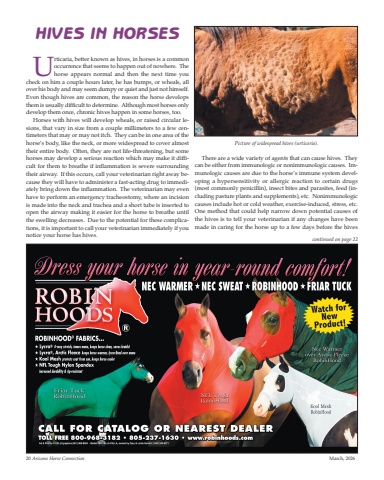
HIVES IN HORSESUrticaria, better known as hives, in horses is a commonoccurrence that seems to happen out of nowhere. Thehorse appears normal and then the next time youcheck on him a couple hours later, he has bumps, or wheals, allover his body and may seem dumpy or quiet and just not himself.Even though hives are common, the reason the horse developsthem is usually difficult to determine. Although most horses onlydevelop them once, chronic hives happen in some horses, too.Horses with hives will develop wheals, or raised circular lesions, that vary in size from a couple millimeters to a few centimeters that may or may not itch. They can be in one area of thehorse%u2019s body, like the neck, or more widespread to cover almosttheir entire body. Often, they are not life-threatening, but somehorses may develop a serious reaction which may make it difficult for them to breathe if inflammation is severe surroundingtheir airway. If this occurs, call your veterinarian right away because they will have to administer a fast-acting drug to immediately bring down the inflammation. The veterinarian may evenhave to perform an emergency tracheostomy, where an incisionis made into the neck and trachea and a short tube is inserted toopen the airway making it easier for the horse to breathe untilthe swelling decreases. Due to the potential for these complications, it is important to call your veterinarian immediately if younotice your horse has hives.There are a wide variety of agents that can cause hives. Theycan be either from immunologic or nonimmunologic causes. Immunologic causes are due to the horse%u2019s immune system developing a hypersensitivity or allergic reaction to certain drugs(most commonly penicillin), insect bites and parasites, feed (including pasture plants and supplements), etc. Nonimmunologiccauses include hot or cold weather, exercise-induced, stress, etc.One method that could help narrow down potential causes ofthe hives is to tell your veterinarian if any changes have beenmade in caring for the horse up to a few days before the hivesPicture of widespread hives (urticaria). 20 Arizona Horse Connection March, 2026continued on page 22


