


Page 60 - Demo
P. 60
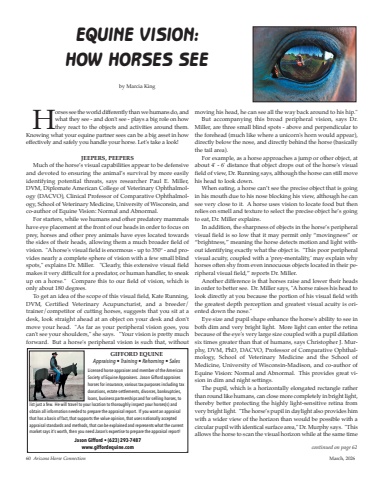
Horses see the world differently than we humans do, andwhat they see - and don't see - plays a big role on howthey react to the objects and activities around them.Knowing what your equine partner sees can be a big asset in howeffectively and safely you handle your horse. Let's take a look!JEEPERS, PEEPERSMuch of the horse%u2019s visual capabilities appear to be defensiveand devoted to ensuring the animal%u2019s survival by more easilyidentifying potential threats, says researcher Paul E. Miller,DVM, Diplomate American College of Veterinary Ophthalmology (DACVO), Clinical Professor of Comparative Ophthalmology, School of Veterinary Medicine, University of Wisconsin, andco-author of Equine Vision: Normal and Abnormal.For starters, while we humans and other predatory mammalshave eye placement at the front of our heads in order to focus onprey, horses and other prey animals have eyes located towardsthe sides of their heads, allowing them a much broader field ofvision. \vides nearly a complete sphere of vision with a few small blindspots,\makes it very difficult for a predator, or human handler, to sneakup on a horse.\only about 180 degrees.To get an idea of the scope of this visual field, Kate Running,DVM, Certified Veterinary Acupuncturist, and a breeder/trainer/competitor of cutting horses, suggests that you sit at adesk, look straight ahead at an object on your desk and don'tmove your head. \can't see your shoulders,\forward. But a horse's peripheral vision is such that, withoutmoving his head, he can see all the way back around to his hip.\But accompanying this broad peripheral vision, says Dr.Miller, are three small blind spots - above and perpendicular tothe forehead (much like where a unicorn's horn would appear),directly below the nose, and directly behind the horse (basicallythe tail area). For example, as a horse approaches a jump or other object, atabout 4' - 6' distance that object drops out of the horse's visualfield of view, Dr. Running says, although the horse can still movehis head to look down. When eating, a horse can%u2019t see the precise object that is goingin his mouth due to his nose blocking his view, although he cansee very close to it. A horse uses vision to locate food but thenrelies on smell and texture to select the precise object he%u2019s goingto eat, Dr. Miller explains.In addition, the sharpness of objects in the horse%u2019s peripheralvisual field is so low that it may permit only %u201cmovingness%u201d or%u201cbrightness,%u201d meaning the horse detects motion and light without identifying exactly what the object is. \visual acuity, coupled with a 'prey-mentality,' may explain whyhorses often shy from even innocuous objects located in their peripheral visual field,%u201d reports Dr. Miller.Another difference is that horses raise and lower their headsin order to better see. Dr. Miller says, \look directly at you because the portion of his visual field withthe greatest depth perception and greatest visual acuity is oriented down the nose.\Eye size and pupil shape enhance the horse's ability to see inboth dim and very bright light. More light can enter the retinabecause of the eye's very large size coupled with a pupil dilationsix times greater than that of humans, says Christopher J. Murphy, DVM, PhD, DACVO, Professor of Comparative Ophthalmology, School of Veterinary Medicine and the School ofMedicine, University of Wisconsin-Madison, and co-author ofEquine Vision: Normal and Abnormal. This provides great vision in dim and night settings. The pupil, which is a horizontally elongated rectangle ratherthan round like humans, can close more completely in bright light,thereby better protecting the highly light-sensitive retina fromvery bright light. \with a wider view of the horizon than would be possible with acircular pupil with identical surface area,\allows the horse to scan the visual horizon while at the same timeEQUINE VISION: HOW HORSES SEEby Marcia King60 Arizona Horse Connection March, 2026GIFFORD EQUINEAppraising %u2022 Training %u2022 Rehoming %u2022 SalesLicensed horse appraiser and member of the AmericanSociety of Equine Appraisers. Jason Gifford appraiseshorses for insurance, various tax purposes including taxdonations, estate settlements, divorces, bankruptcies,loans, business partnerships and for selling horses, tolist just a few. He will travel to your location to thoroughly inspect your horses(s) and obtain all information needed to prepare the appraisal report. If you want an appraisalthat has a basis of fact, that supports the value opinion, that uses nationally accepted appraisal standards and methods, that can be explained and represents what the currentmarket says it%u2019s worth, then you need Jason%u2019s expertise to prepare the appraisal report!Jason Gifford %u2022 (623) 293-7487www.giffordequine.com continued on page 62


