


Page 54 - Demo
P. 54
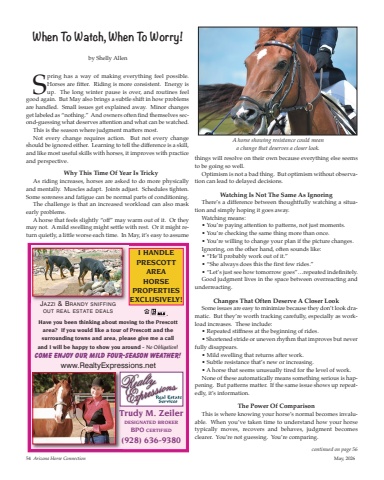
Spring has a way of making everything feel possible.Horses are fitter. Riding is more consistent. Energy isup. The long winter pause is over, and routines feelgood again. But May also brings a subtle shift in how problemsare handled. Small issues get explained away. Minor changesget labeled as “nothing.” And owners often find themselves second-guessing what deserves attention and what can be watched.This is the season where judgment matters most.Not every change requires action. But not every changeshould be ignored either. Learning to tell the difference is a skill,and like most useful skills with horses, it improves with practiceand perspective.Why This Time Of Year Is TrickyAs riding increases, horses are asked to do more physicallyand mentally. Muscles adapt. Joints adjust. Schedules tighten.Some soreness and fatigue can be normal parts of conditioning.The challenge is that an increased workload can also maskearly problems.A horse that feels slightly “off” may warm out of it. Or theymay not. A mild swelling might settle with rest. Or it might return quietly, a little worse each time. In May, it’s easy to assumethings will resolve on their own because everything else seemsto be going so well.Optimism is not a bad thing. But optimism without observation can lead to delayed decisions.Watching Is Not The Same As IgnoringThere’s a difference between thoughtfully watching a situation and simply hoping it goes away.Watching means:• You’re paying attention to patterns, not just moments.• You’re checking the same thing more than once.• You’re willing to change your plan if the picture changes.Ignoring, on the other hand, often sounds like:• “He’ll probably work out of it.”• “She always does this the first few rides.”• “Let’s just see how tomorrow goes”…repeated indefinitely.Good judgment lives in the space between overreacting andunderreacting.Changes That Often Deserve A Closer LookSome issues are easy to minimize because they don’t look dramatic. But they’re worth tracking carefully, especially as workload increases. These include:• Repeated stiffness at the beginning of rides.• Shortened stride or uneven rhythm that improves but neverfully disappears.• Mild swelling that returns after work.• Subtle resistance that’s new or increasing.• A horse that seems unusually tired for the level of work.None of these automatically means something serious is happening. But patterns matter. If the same issue shows up repeatedly, it’s information.The Power Of ComparisonThis is where knowing your horse’s normal becomes invaluable. When you’ve taken time to understand how your horsetypically moves, recovers and behaves, judgment becomesclearer. You’re not guessing. You’re comparing.When To Watch, When To Worry!by Shelly Allencontinued on page 5654 Arizona Horse Connection May, 2026A horse showing resistance could mean a change that deserves a closer look.JAZZI & BRANDY SNIFFINGOUT REAL ESTATE DEALSTrudy M. ZeilerDESIGNATED BROKERBPO CERTIFIED(928) 636-9380Have you been thinking about moving to the Prescottarea? If you would like a tour of Prescott and the surrounding towns and area, please give me a call and I will be happy to show you around - No Obligation!Come enjoy our mild four-season weather!www.RealtyExpressions.netI HANDLEPRESCOTTAREA HORSE PROPERTIES EXCLUSIVELY!


