


Page 55 - Demo
P. 55
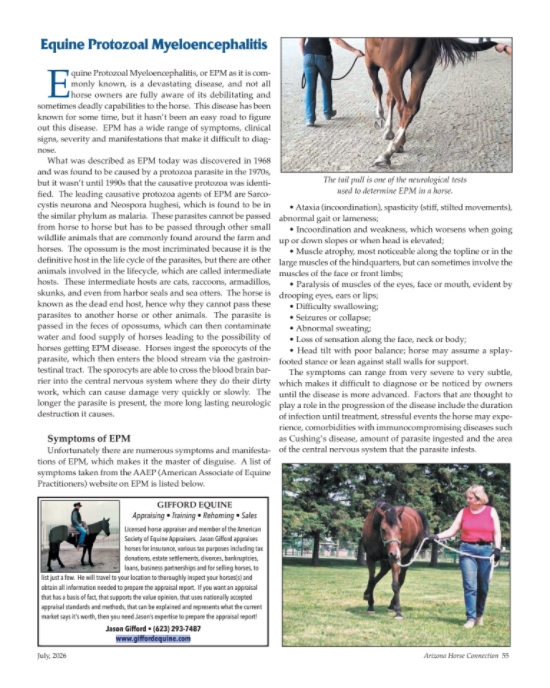
Equine Protozoal MyeloencephalitisEquine Protozoal Myeloencephalitis, or EPM as it is commonly known, is a devastating disease, and not allhorse owners are fully aware of its debilitating andsometimes deadly capabilities to the horse. This disease has beenknown for some time, but it hasn%u2019t been an easy road to figureout this disease. EPM has a wide range of symptoms, clinicalsigns, severity and manifestations that make it difficult to diagnose. What was described as EPM today was discovered in 1968and was found to be caused by a protozoa parasite in the 1970s,but it wasn%u2019t until 1990s that the causative protozoa was identified. The leading causative protozoa agents of EPM are Sarcocystis neurona and Neospora hughesi, which is found to be inthe similar phylum as malaria. These parasites cannot be passedfrom horse to horse but has to be passed through other smallwildlife animals that are commonly found around the farm andhorses. The opossum is the most incriminated because it is thedefinitive host in the life cycle of the parasites, but there are otheranimals involved in the lifecycle, which are called intermediatehosts. These intermediate hosts are cats, raccoons, armadillos,skunks, and even from harbor seals and sea otters. The horse isknown as the dead end host, hence why they cannot pass theseparasites to another horse or other animals. The parasite ispassed in the feces of opossums, which can then contaminatewater and food supply of horses leading to the possibility ofhorses getting EPM disease. Horses ingest the sporocyts of theparasite, which then enters the blood stream via the gastrointestinal tract. The sporocyts are able to cross the blood brain barrier into the central nervous system where they do their dirtywork, which can cause damage very quickly or slowly. Thelonger the parasite is present, the more long lasting neurologicdestruction it causes.Symptoms of EPMUnfortunately there are numerous symptoms and manifestations of EPM, which makes it the master of disguise. A list ofsymptoms taken from the AAEP (American Associate of EquinePractitioners) website on EPM is listed below.%u2022 Ataxia (incoordination), spasticity (stiff, stilted movements),abnormal gait or lameness;%u2022 Incoordination and weakness, which worsens when goingup or down slopes or when head is elevated;%u2022 Muscle atrophy, most noticeable along the topline or in thelarge muscles of the hindquarters, but can sometimes involve themuscles of the face or front limbs;%u2022 Paralysis of muscles of the eyes, face or mouth, evident bydrooping eyes, ears or lips;%u2022 Difficulty swallowing;%u2022 Seizures or collapse;%u2022 Abnormal sweating;%u2022 Loss of sensation along the face, neck or body;%u2022 Head tilt with poor balance; horse may assume a splayfooted stance or lean against stall walls for support.The symptoms can range from very severe to very subtle,which makes it difficult to diagnose or be noticed by ownersuntil the disease is more advanced. Factors that are thought toplay a role in the progression of the disease include the durationof infection until treatment, stressful events the horse may experience, comorbidities with immunocompromising diseases suchas Cushing%u2019s disease, amount of parasite ingested and the areaof the central nervous system that the parasite infests.July, 2026 Arizona Horse Connection 55The tail pull is one of the neurological tests used to determine EPM in a horse.GIFFORD EQUINEAppraising %u2022 Training %u2022 Rehoming %u2022 SalesLicensed horse appraiser and member of the AmericanSociety of Equine Appraisers. Jason Gifford appraiseshorses for insurance, various tax purposes including taxdonations, estate settlements, divorces, bankruptcies,loans, business partnerships and for selling horses, tolist just a few. He will travel to your location to thoroughly inspect your horses(s) and obtain all information needed to prepare the appraisal report. If you want an appraisalthat has a basis of fact, that supports the value opinion, that uses nationally accepted appraisal standards and methods, that can be explained and represents what the currentmarket says it%u2019s worth, then you need Jason%u2019s expertise to prepare the appraisal report!Jason Gifford %u2022 (623) 293-7487www.giffordequine.com


